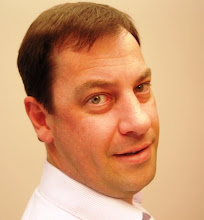
Here is a prayer read by Archbishop Phillip Aspinall at our group devotions in Jerusalem this morning (10 Dec 2007) in preparation for the journey to Bethlehem:
Lord Jesus Christ,
Today we share your tears for the cities of the world;
Still we have not loved the things that make for peace.
We weep for the divided cities:
Where brother fights with brother,
Where anger feeds on hatred,
Where prejudice blinds the eyes of compassion,
And even religion divides,
Where children are taught to hate,
And old men relish ancient wrongs.
We weep for the cities of oppression:
Where iron law imprisons freedom,
Where thought is curbed and conscience is stifled,
Where the questioning spirit is called a traitor,
Where art and civilising truth grow barren,
And each must think in manner as his neighbour.
We weep for the cities of poverty:
Where children live, but die too soon,
Where eager hands can find no work,
Where hunger rules and aid is short,
Where mothers clutch uncomprehending young,
And where the little we could do, we fail to do.
We weep for our cities and for ourselves;
We have not learned the things that make for peace.
Lord, turn
Tears to love
And love to work.
Turn work to justice
And all that makes for peace.
Amen.
Monday, December 31, 2007


Visit to Yad Vashem
 Today (Monday 10 Dec 2007) we moved from Jerusalem to Bethlehem, with important diversions. The first was a visit to Yad Vashem, the Holocaust Martyrs' and Heroes' Remembrance Authority, and its flagship attraction, the Holocaust History Museum.
Most striking to me was the huge concrete bunker, vaguely reminiscent of a Chinese temple, housing the museum's displays. An Israeli Jew who is active in the peace movement guided us through the museum, and I found her commentary both professional and honest. We were not permitted to take pictures inside the museum.
For me, this magnificent historical record imparts two parallel messages. First, Yad Vashem provides a powerful reminder of the horror and extent of totalitarian oppression and the repression of ethnic minorities, and the unfathomable depths to which the human spirit can sink in the pursuit of power.
Having visited the Sydney Jewish Museum twice (I take Baptist theological students there as part of their ethics studies), I would say that it equals Yad Vashem in the quality and focus of its presentation of the Holocaust story. We can learn much about human suffering and loss, about the resilience and nobility of the human spirit in the face of injustice on an unimaginable scale, on the depths to which humans are capable of sinking when they regard other people as less than human, from reflecting on the stories of Jewish victims of Nazi oppression and genocide.
 What Yad Vashem adds to the experience is its symbolic location (in the land of Israel), the pleasure of seeing many Israeli Jews passing slowly and studiously through the museum, and the deeply moving Hall of Names (pictured at right) which aims to identify and collect the names and personal records of all Jews murdered in the Holocaust.
Many of us have long heard the words "six million" in reference to the full Holocaust death toll. None of us has ever seen six million people, nor can we imagine so many faces together in one place. The risk in remembering the Holocaust death toll as a number is that the individuality of the murdered victims is bypassed. Yet each one was a person with rights and responsibilities just as you and I have. As Benjamin Fondane put it before he was murdered at Auchwitz in 1944: "Remember only that I was innocent and, just like you, mortal on that day, I, too, had had a face marked by rage, by pity and joy, quite simply, a human face!”
Second, having heard many stories from the lips of present-day suffering Palestinians and concerned Israelis, the testimony of Yad Vashem is that the world community, including the Israeli and Palestinian communities, must continue to learn from the most painful 20th-century experience of the Jewish people.
I am not alone in observing that uncomfortable (indeed obscene) similarities have been made between what occurred in Europe in the 1930s and 1940s and what has been contemplated against Palestinian Arabs by elements within the Israeli political and military elite. Many reasonable people will view such associations as either inflammatory or invalid, but I believe we should have the courage to "name the elephant in the room" and commit ourselves to rational dialogue and constructive action aimed at mutual understanding and a just peace. In applying this idiom here, I am not speaking of "truth" but of "perception." It is when we stop talking together in a civil manner that problems begin to grow.
Important differences have been observed too: the most obvious of which are that the Israeli Government is not engaged in a program of genocide but of legitimate self-defence against political and ideological enemies operating outside the rules of war; and that European Jews did not employ suicide bombers to make their political points, as some Palestinians have done and continue to do.
What can be said in response to such observations?
Each of us should employ the gifts of memory, world-knowledge, self-knowledge, critical analysis and wisdom we are given from God, and with the fruits of these gifts begin to shape a world that more fully reflects the values of justice, mercy and peace defined by the Torah and the other Jewish sacred writings.
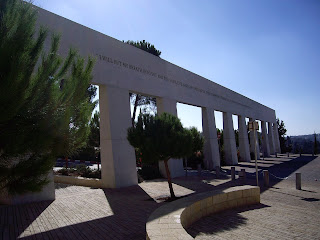


Pictures:
1. Yad Vashem panorama, courtesy Vad Vashem website.
2. Hall of Names (partial interior), Yad Vashem website.
3. Edifice near entrance to Yad Vashem, quoting Ezekiel 37:14.
4. Exit of Yad Vashem Museum, looking toward the suburbs of Jerusalem.
5. Rev Merrill Kitchen lays a wreath in memory of the millions of European Jews murdered by Nazis.
6. Museum exit precinct.
7. Israeli flags and list of benefactors, Yad Vashem.
Saturday, December 29, 2007
Lutheran World Federation urges peace in Palestine
The Lutheran World Federation has appealed to Israeli and Palestinian leaders to “urgently pursue” the successful conclusion of a peace treaty between their nations, as agreed at the recent Middle East peace conference in Annapolis in the US.
At a full day of meetings in Annapolis in Maryland last month, Israeli and Palestinian Authority leaders announced that they had agreed to negotiate a peace treaty to establish a Palestinian state, with the goal of concluding the treaty by the end of 2008 – before Bush leaves office.
The LWF General Secretary Rev Dr Ishmael Noko pressed home the need for the two sides to continue where they left off in a letter sent to Israeli Prime Minister Ehud Olmert and Palestinian Authority President Mahmoud Abbas on Tuesday.
In his letter, he stressed that the LWF and its member churches around the world welcomed "wholeheartedly ... the revival of the fresh hopes for peace in the Holy Land" following Annapolis.
Noko quoted an open letter from Palestinian Lutheran Bishop Dr Munib A Younan to world leaders ahead of the Annapolis conference which stated that churches were "called to be a people of hope and choose not only to see the cup as half full but to commit ourselves to whatever it takes to make the cup overflow".
The LWF General Secretary admitted that the 2008 deadline for a conclusion to the ongoing Israeli-Palestinian peace negotiations was “incredibly ambitious”. He noted, however, that it was “entirely necessary”, stressing the need for the leaders to drive forward with measures that would restore trust between the two sides “in order to create an environment in which peace can flower”.
Noko assured the Israeli and Palestinian leaders of the “constant and fervent prayers” of the LWF community throughout the next round of negotiations due to start on 12 December.
He added, however, that the leaders also needed to do everything they could to agree a peace treaty “resolving all outstanding issues and resulting in two states, Israel and Palestine, living side by side in peace and security – and the establishment of peace with justice in the Holy Land”.
The LWF would, he assured, keep up its ongoing work with other faith communities in the region to “counter despair and desperation”.
Noko also referred to a statement from the Council for Religious Institutions of the Holy Land in November in which Christian, Jewish and Muslim leaders in the region affirmed their “responsibility to find the right way to live together in peace rather than to fight and kill one another”.
Following the Annapolis conference, Younan also challenged world leaders to turn their goodwill gestures and peace-speak into a reality.
“So far it’s just a signature; now they have to walk the talk,” said Munib Younan, the Bishop of the Evangelical Lutheran Church in Jordan and the Holy Land, according to the World Council of Churches.
He added, “I do hope this is a serious attempt to achieve a lasting peace.”
Christian Today 6 Dec 2007
At a full day of meetings in Annapolis in Maryland last month, Israeli and Palestinian Authority leaders announced that they had agreed to negotiate a peace treaty to establish a Palestinian state, with the goal of concluding the treaty by the end of 2008 – before Bush leaves office.
The LWF General Secretary Rev Dr Ishmael Noko pressed home the need for the two sides to continue where they left off in a letter sent to Israeli Prime Minister Ehud Olmert and Palestinian Authority President Mahmoud Abbas on Tuesday.
In his letter, he stressed that the LWF and its member churches around the world welcomed "wholeheartedly ... the revival of the fresh hopes for peace in the Holy Land" following Annapolis.
Noko quoted an open letter from Palestinian Lutheran Bishop Dr Munib A Younan to world leaders ahead of the Annapolis conference which stated that churches were "called to be a people of hope and choose not only to see the cup as half full but to commit ourselves to whatever it takes to make the cup overflow".
The LWF General Secretary admitted that the 2008 deadline for a conclusion to the ongoing Israeli-Palestinian peace negotiations was “incredibly ambitious”. He noted, however, that it was “entirely necessary”, stressing the need for the leaders to drive forward with measures that would restore trust between the two sides “in order to create an environment in which peace can flower”.
Noko assured the Israeli and Palestinian leaders of the “constant and fervent prayers” of the LWF community throughout the next round of negotiations due to start on 12 December.
He added, however, that the leaders also needed to do everything they could to agree a peace treaty “resolving all outstanding issues and resulting in two states, Israel and Palestine, living side by side in peace and security – and the establishment of peace with justice in the Holy Land”.
The LWF would, he assured, keep up its ongoing work with other faith communities in the region to “counter despair and desperation”.
Noko also referred to a statement from the Council for Religious Institutions of the Holy Land in November in which Christian, Jewish and Muslim leaders in the region affirmed their “responsibility to find the right way to live together in peace rather than to fight and kill one another”.
Following the Annapolis conference, Younan also challenged world leaders to turn their goodwill gestures and peace-speak into a reality.
“So far it’s just a signature; now they have to walk the talk,” said Munib Younan, the Bishop of the Evangelical Lutheran Church in Jordan and the Holy Land, according to the World Council of Churches.
He added, “I do hope this is a serious attempt to achieve a lasting peace.”
Christian Today 6 Dec 2007
Monday, December 24, 2007
Meeting with Bishop Suheil Dawani
 In the evening of Sunday 9 Dec 2007, our Australian delegation met with Episcopal Bishop Suheil Dawani in a meeting room at St George's Cathedral in West Jerusalem.
Bishop Dawini told us, as many other Palestinian Christians have pointed out, that it is critically important to keep the "living stones" as well as the "historical stones" in Jerusalem. While many thousands of people visit the great holy sites of the Holy Land every year, the long exodus of wealthy and well educated Palestinians from the land continues. Today only about two per cent of the population is Palestinian - because of Palestinians leaving, Jews arriving throughout the past century, and Arabs tending to have large families (in refugee camps it is not unusual for parents to have 10-15 children).
More alarming still, Bishop Dawani said, is that "Our young people have lost hope for the future. Those who can, they leave Palestine for education, and they do not come back to this desperate situation."
Although the Cathedral has a small regular congregation, it supports 37 benevolent and educational institutions. For more information see http://www.j-diocese.org/.
Picture (L-R): Mr Yusef Daher, Archbishop Phillip Aspinall and Bishop Suheil Dawani, at St George's Cathedral, West Jerusalem.
Although the Cathedral has a small regular congregation, it supports 37 benevolent and educational institutions. For more information see http://www.j-diocese.org/.
Picture (L-R): Mr Yusef Daher, Archbishop Phillip Aspinall and Bishop Suheil Dawani, at St George's Cathedral, West Jerusalem.
Meeting with Sabeel
On Sunday evening (9 Dec 2007) the Australian delegation met with four female representatives of Sabeel, the Ecumenical Liberation Theology Center, a Jerusalem-based agency focused on justice and nonviolence. "Sabeel" is Arabic for "the Way," and for "water spring." I recommend you explore the main Sabeel website, and also the various Friends of Sabeel branches overseas. For Australians:
Friends of Sabeel Oceana Inc.
PO Box 4474
Forest Lake, Qld 4078
Email: sabeel at the domain faithfutures.org
Sabeel also publishes many high quality books and booklets, some of which will be reviewed in later blogs on this site.


Pictures:
1. Entrance to Sabeel, Jerusalem.
2. Sabeel board member Mrs Samia Khoury (left), speaking to Australian delegates and Sabeel members.
3. Sabeel Communities Coordinator Mrs Nora Karmi (centre) speaking to Australian delegates and Sabeel members; to her left is Rev Merrill Kitchen; to her right is Canadian Sabeel member Ms Cathy Nichols with her child.
Friends of Sabeel Oceana Inc.
PO Box 4474
Forest Lake, Qld 4078
Email: sabeel at the domain faithfutures.org
Sabeel also publishes many high quality books and booklets, some of which will be reviewed in later blogs on this site.
Pictures:
1. Entrance to Sabeel, Jerusalem.
2. Sabeel board member Mrs Samia Khoury (left), speaking to Australian delegates and Sabeel members.
3. Sabeel Communities Coordinator Mrs Nora Karmi (centre) speaking to Australian delegates and Sabeel members; to her left is Rev Merrill Kitchen; to her right is Canadian Sabeel member Ms Cathy Nichols with her child.
Meeting with the American Jewish Committee
 After lunch on Sunday 9 Dec 2007, our delegation met with Rabbi Ed Retting at the American Jewish Committee. He represented Rabbi David Rosen, who was travelling overseas.
 According to its website, "the American Jewish Committee, established in 1906 by a small group of American Jews deeply concerned about pogroms aimed at Russian Jews, determined that the best way to protect Jewish populations in danger would be to work towards a world in which all peoples were accorded respect and dignity.Over 100 years later, AJC continues its efforts to promote pluralistic and democratic societies where all minorities are protected. AJC is an international think tank and advocacy organization that attempts to identify trends and problems early - and take action."
The AJC's key areas of focus are:
Combating anti-Semitism and all forms of bigotry;Promoting pluralism and shared democratic values;Supporting Israel's quest for peace and security;Advocating for energy independence;Strengthening Jewish life.
Rabbi Ed Retting described the American Jewish Committee as a "de facto foreign office for the American Jewish community," and a "defense agency" (a US administrative category); it is politically and religiously unaffiliated, with a membership of about 180,000.
Of particular note in Rabbi Retting's briefing was his categorisation of Israeli settlers in the West Bank into three classes:
(a) 80 per cent "non-ideological non-exclusivists";
(b) 15 per cent "idealistic moderates" aware of the problem;
(c) 5 per cent "the biggest bunch of hooligans and nut-cases I have ever had the misfortune to know."
Some quotes:
"Jewish society is split roughly 80-20 between 'hawks' and 'doves'."
"The biggest problem is that the Palestinians don't know us on our own terms."
"The Palestinians treat us like a Mack truck that jumped the guardrail and caused havoc."
"Saving a life outweighs the whole Torah."
"Building hospitals and schools [in the West Bank] is not about justice."
On the Separation Barrier and the segregated road system in the West Bank: "Separation for a period, as often recommended in marriage counselling, is a good thing because it allows both parties to calm down and see things more rationally."
"Jewish leaders need to ... help the Palestinians reach into their hearts and turn things around."
On Rabbi David Rosen see also http://rabbidavidrosen.net/
Picture: Rabbi Ed Retting addresses the Australian delegates at the American Jewish Committee building in West Jerusalem.
Combating anti-Semitism and all forms of bigotry;Promoting pluralism and shared democratic values;Supporting Israel's quest for peace and security;Advocating for energy independence;Strengthening Jewish life.
Rabbi Ed Retting described the American Jewish Committee as a "de facto foreign office for the American Jewish community," and a "defense agency" (a US administrative category); it is politically and religiously unaffiliated, with a membership of about 180,000.
Of particular note in Rabbi Retting's briefing was his categorisation of Israeli settlers in the West Bank into three classes:
(a) 80 per cent "non-ideological non-exclusivists";
(b) 15 per cent "idealistic moderates" aware of the problem;
(c) 5 per cent "the biggest bunch of hooligans and nut-cases I have ever had the misfortune to know."
Some quotes:
"Jewish society is split roughly 80-20 between 'hawks' and 'doves'."
"The biggest problem is that the Palestinians don't know us on our own terms."
"The Palestinians treat us like a Mack truck that jumped the guardrail and caused havoc."
"Saving a life outweighs the whole Torah."
"Building hospitals and schools [in the West Bank] is not about justice."
On the Separation Barrier and the segregated road system in the West Bank: "Separation for a period, as often recommended in marriage counselling, is a good thing because it allows both parties to calm down and see things more rationally."
"Jewish leaders need to ... help the Palestinians reach into their hearts and turn things around."
On Rabbi David Rosen see also http://rabbidavidrosen.net/
Picture: Rabbi Ed Retting addresses the Australian delegates at the American Jewish Committee building in West Jerusalem.
Meeting with the Israeli Government Press Office
 The only time available for the Israeli Government representatives to meet with our Australian delegation was Sunday morning, which I found extraordinary. However, we agreed to meet Mr Daniel Seaman, the Director of the Government Press Office (GPO), at Beit Agron, in West Jerusalem, at 11.30 am.
 Mr Seaman met us in the library of the Journalists' Association. He talked about the context of the recent Annapolis peace talks, the failings of the Israeli educational system, the wisdom of a two-state solution, the need to oppose extremists in both Israel and Palestine, and many more political and social issues relating to the ongoing conflict.
Some quotes:
"Hoping for a peace agreement by the end of 2008 is upping the anti too much."
"The one-state solution is 'Orwellian-speak' and any resolution to the situation will require tangible concessions to Israel."
"The Arab-Israeli conflict is a golem created by those who wish for it."
"If the Arab world confirms that Iran has nuclear weapons, there will be a whole new dance [in the region]"
"In many places, thugs have taken over the Palestinian National Authority."
"The Separation Wall is a non-violent means of reducing Palestinian terrorism. It alows Israel to restrain itself against aggressors. It is a matter of our lives compared to their convenience."
"The one right that is elementary is the right to self-determination. All other rights are negotiable."
"There are indications that Israel and Syria are in secret negotiations. Syria is an essential party in any peace agreement because it can appear to make Israel weak if sabre-rattling becomes a reality."
"Israel is the Jewish state, just as Arab countries are Muslim states, and Italy, the USA and the UK are Christian states."
"Palestinian Israeli citizens are treated far better than minorities in other 'troubled' nationa are treated ... Our Supreme Court tries to correct problems, but it is hard to do so in the situation we face."
"On the fact of hundreds of roadblocks inside the West Bank: "Every week there are children stopped, carrying explosives."
 "The Security Barrier is permanent, but the Supreme Court can determine its final location."
"Cynicism is not in my job description, but one has to have it in order to be optimistic."
"What we have all been through in the last seven years - none of us wants to go through that in the future."
On one-state versus two-state solution to the Israeli-Palestinian conflict see also an excellent paper by Marian Kromkowski at http://www.onepalestine.org/resources/articles/One_State-Two_State.pdf
Pictures:
1. Mr Daniel Seaman addresses the Australian delegation at Beit Agron.
2. The delegation enjoys lunch at the Spaghettim Restaurant adjacent to Beit Agron (an experience I recommend, though not 'local' cuisine).
Worship at St Georges Cathedral
This morning the various Australian delegates were free to attend services of their respective Christian traditions in Jerusalem. I joined three of our members for worship at the Cathedral Church of St George the Martyr, 20 Nablus Rd, West Jerusalem, near the Damascus Gate. The worship was broadly evangelical, in Arabic and English, and included communion. About 25 local Christians shared the service with us, and enjoyed morning tea of Arabic coffee and Arabic sweets.
At morning tea, I spoke to two men about the conflict and how it has impacted and continues to impact their lives. One, a senior public servant who preferred to remain anonymous, spoke about the 1967 war, claiming it was not a war but "an efficient means of transferring land from Jordan to Israel." Another, a senior administrator in a hospital in the West Bank, described his experience as a child whose family was displaced in the 1948 war; more recently, because of the Separation Barrier, his family was forced to abandon their home and prevented from attending the church with which they had been associated for many years. He drove us past the beautiful stone church and back to our hotel. Such stories could be repeated a thousand-fold, and these people are not terrorists, despite what they have suffered and lost.
Incidentally, few people realise that St George was not British but Palestinian (yes, that's right, the guy who fought the Dragon). He is reputed to have been born in Bithynia to a Palestinian mother, and died as a martyr in Palestine, executed by Roman Emperor Diocletian.

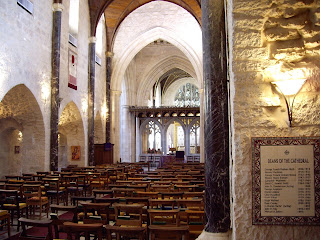 Pictures:
1. (L-R): Rev Merrill Kitchen, Dr Kevin Bray, Bishop Suheil Dawani, Archbishop Phillip Aspinall, at the entrance to the cloister of St George's Cathedral.
2. Interior of the Cathedral.
Trivia: Ship of Fools Mystery Worshipper has logged a visit to St George's Cathedral (and, like me, liked the experience).
At morning tea, I spoke to two men about the conflict and how it has impacted and continues to impact their lives. One, a senior public servant who preferred to remain anonymous, spoke about the 1967 war, claiming it was not a war but "an efficient means of transferring land from Jordan to Israel." Another, a senior administrator in a hospital in the West Bank, described his experience as a child whose family was displaced in the 1948 war; more recently, because of the Separation Barrier, his family was forced to abandon their home and prevented from attending the church with which they had been associated for many years. He drove us past the beautiful stone church and back to our hotel. Such stories could be repeated a thousand-fold, and these people are not terrorists, despite what they have suffered and lost.
Incidentally, few people realise that St George was not British but Palestinian (yes, that's right, the guy who fought the Dragon). He is reputed to have been born in Bithynia to a Palestinian mother, and died as a martyr in Palestine, executed by Roman Emperor Diocletian.
Pictures:1. (L-R): Rev Merrill Kitchen, Dr Kevin Bray, Bishop Suheil Dawani, Archbishop Phillip Aspinall, at the entrance to the cloister of St George's Cathedral.
2. Interior of the Cathedral.
Trivia: Ship of Fools Mystery Worshipper has logged a visit to St George's Cathedral (and, like me, liked the experience).
Meeting with the Quakers at Ramallah
While in Ramallah, our Australian delegation met with Dr Jean Zaru, Sam Bahour and the Mayor of Ramallah at the Religious Society of Friends (aka Quakers) building. Dr Zaru talked to us about nonviolent action for peace in Israel and Palestine, the negative influence of Christian fundamentalist extremists, and the usefulness of "alternative Christian pilgrimages" to the Holy Land. A powerpoint presentation of her talk is available. More information about Jean Zaru is available here and here.
Sam Bahour, a businessman from America who has worked in Palestine for 14 years, talked to us about economic development under Israeli occupation, the crucial importance of education, and appropriate forms of activism in the face of military occupation. He recommended the Right to Enter campaign. Some quotes: "If you can't implement international law, what use is it?" And "Israel works on many fronts to compel Palestinians to leave voluntarily for other countries." More information on Sam Bahour is available here and here and here.
The Mayor of Ramallah, Janet Mikhail, arrived as we were leaving, and greeted us warmly.


Pictures:
1. The Australian delegation entering the Ramallah Friends' Meeting House.
2. The delegation sharing a light snack before being addressed by Jean Zaru (standing, centre).
3. Ramallah Mayor (left) and Jean Zaru.
More information on Quakers:
Sam Bahour, a businessman from America who has worked in Palestine for 14 years, talked to us about economic development under Israeli occupation, the crucial importance of education, and appropriate forms of activism in the face of military occupation. He recommended the Right to Enter campaign. Some quotes: "If you can't implement international law, what use is it?" And "Israel works on many fronts to compel Palestinians to leave voluntarily for other countries." More information on Sam Bahour is available here and here and here.
The Mayor of Ramallah, Janet Mikhail, arrived as we were leaving, and greeted us warmly.
Pictures:
1. The Australian delegation entering the Ramallah Friends' Meeting House.
2. The delegation sharing a light snack before being addressed by Jean Zaru (standing, centre).
3. Ramallah Mayor (left) and Jean Zaru.
More information on Quakers:
- Ramallah Quakers
- Quaker.org
- Wikipedia article on "Religious Society of Friends."
- Australian Quakers
Meeting with the Palestinian National Authority
Leaving the Mount of Olives, we travelled north through occupied Palestinian territory to Ramallah, the administrative capital of Palestine. Ramallah is a bustling, if dirty, city, with plenty of evidence of construction and other economic activity. We visited the impressive memorial to Nobel Peace Prize winner Yasser Arafat, and met with His Excellency Rafiq Husseini, chief of staff to Palestinian President Mahmoud Abbas.
Mr Husseini is a gifted leader and thinker, and it impressed me that he has chosen to remain in Palestine when many alternative avenues must have been open to him. He is also a Christian. His was perhaps the most comprehensive and cogent briefing that we received during our visit to Israel and Palestine.
Essentially, Mr Husseini impressed on us the following points:
1. Israel must withdraw to the original Green Line, leaving Palestine with 22 per cent of the whole territory of Israel/Palestine (although Israel regards this as untenable).
2. Israel must stop building new settlements, and enlarging existing settlements, in the West Bank.
3. Israel must not become a Jewish state, and Palestine must not become a Muslim state.
Something of his recent thinking on the Israeli-Palestinian conflict is published at the following locations:


 Pictures:
1. Main street in Ramallah.
2. The delegation approaches the new Memorial to Yasser Arafat, adjacent to the Palestinian National Authority building.
3. Interior of the Memorial.
4. The delegation in discussion with His Excellency Rafiq Husseini, at the Palestinian National Authority.
Mr Husseini is a gifted leader and thinker, and it impressed me that he has chosen to remain in Palestine when many alternative avenues must have been open to him. He is also a Christian. His was perhaps the most comprehensive and cogent briefing that we received during our visit to Israel and Palestine.
Essentially, Mr Husseini impressed on us the following points:
1. Israel must withdraw to the original Green Line, leaving Palestine with 22 per cent of the whole territory of Israel/Palestine (although Israel regards this as untenable).
2. Israel must stop building new settlements, and enlarging existing settlements, in the West Bank.
3. Israel must not become a Jewish state, and Palestine must not become a Muslim state.
Something of his recent thinking on the Israeli-Palestinian conflict is published at the following locations:
- http://lwvlaplata.org/files/a_palestinian_view11-28.pdf
- http://lwvlaplata.org/files/a_palestinian_view11-28.pdf
- See also http://www.dissidentvoice.org/2007/11/the-turbulent-winds-of-the-annapolis-conference/
Pictures:1. Main street in Ramallah.
2. The delegation approaches the new Memorial to Yasser Arafat, adjacent to the Palestinian National Authority building.
3. Interior of the Memorial.
4. The delegation in discussion with His Excellency Rafiq Husseini, at the Palestinian National Authority.
Visit to the Mount of Olives
This afternoon (Saturday 8 Dec 2007), Rev Kjell Jonasson took our Australian delegation to visit the Mount of Olives, in East Jerusalem, just across from the Kidron valley, the deep ravine that Jesus knew so well.
Here we took in the awesome view of the Old City of Jerusalem, and spent some time in reflection, aware that in this place Jesus shed tears and prayed for the city and its people. Together we prayed the following prayer aloud:


 Pictures:
1. The Australian delegation (L-R: Archbishop Phillip Aspinall, Rev Merrill Kitchen, Lyndsay Farrell, Rev Gregor Henderson, Rev Terence Corkin, Rev Rod Benson, Archbishop Frank Carroll, Dr Kevin Bray, Rev John Henderson).
2. Jerusalem looking west from the Mount of Olives.
3. A camel that happened to be resting at the lookout (actually a famous camel whose image adorns postcards and tourist guides).
Here we took in the awesome view of the Old City of Jerusalem, and spent some time in reflection, aware that in this place Jesus shed tears and prayed for the city and its people. Together we prayed the following prayer aloud:
Lord Jesus Christ,
Today we share your tears for the cities of the world;
Still we have not loved the things that make for peace.
We weep for the divided cities:
Where brother fights with brother,
Where anger feeds on hatred,
Where prejudice blinds the eyes of compassion,
And even religion divides,
Where children are taught to hate,
And old men relish ancient wrongs.
We weep for the cities of oppression:
Where iron law imprisons freedom,
Where thought is curbed and conscience is stifled,
Where the questioning spirit is called a traitor,
Where art and civilising truth grow barren,
And each must think in manner as his neighbour.
We weep for the cities of poverty:
Where children live, but die too soon,
Where eager hands can find no work,
Where hunger rules and aid is short,
Where mothers clutch uncomprehending young,
And where the little we could do, we fail to do.
We weep for our cities and for ourselves;
We have not learned the things that make for peace.
Lord, turn
Tears to love
And love to work.
Turn work to justice
And all that makes for peace.
Amen.
Pictures:1. The Australian delegation (L-R: Archbishop Phillip Aspinall, Rev Merrill Kitchen, Lyndsay Farrell, Rev Gregor Henderson, Rev Terence Corkin, Rev Rod Benson, Archbishop Frank Carroll, Dr Kevin Bray, Rev John Henderson).
2. Jerusalem looking west from the Mount of Olives.
3. A camel that happened to be resting at the lookout (actually a famous camel whose image adorns postcards and tourist guides).
Visit to the al-Aqsa Mosque
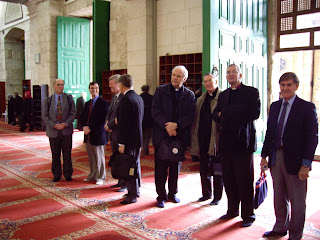
After our visit with the Mufti of Jerusalem and the Chief Judge of the Islamic Court, our Australian delegation visited the al-Aqsa Mosque. Below are some of the images I recorded during our visit. The atmosphere was the same as that experienced inside the Dome of the Rock. Again, it was a privilege and an honour to visit this sacred site.



Meeting the Mufti of Jerusalem
From the Dome of the Rock our Australian delegation was ushered to the offices of His Eminence the Mufti of Jerusalem, who welcomed us (in Arabic) and introduced us to an unexpected guest, His Excellency Sheikh Tayseer Bayoud Tamimi, the Chief Judge of the Islamic Court. They apologised for the delay in gaining entry to the Temple Mount, and observed that we had experienced a small part of "the intentional harassment of the entire Palestinian community." They described the Security Barrier as the "Discrimination Wall," and stated their belief that "the Holy City is under Israeli siege." Much more was said, including answers to questions from our group.
On behalf of our delegation, Archbishop Phillip Aspinall formally apologised for the reprehensible act of one of our fellow Australian citizens in 1969 that caused a devastating fire in the al-Aqsa Mosque. The Chief Judge accepted our apology.
Background to the fire from Wikipedia:
In the morning of August 21, 1969, a fire at Masjid al-Aqsa, gutted the southeastern wing of the mosque. The fire destroyed a priceless one-thousand-year-old wood and ivory pulpit (minbar) that had been sent from Aleppo by Saladin. The "twin" of this minbar (Saladin had them both made at the same time) is still extant in the mosque at the Cave of the Patriarchs in Hebron. Michael Dennis Rohan, a tourist from Australia, was arrested for the arson attack on August 23, 1969. Rohan was a Protestant follower of an evangelical sect known as the Church of God. By his own admission, Rohan hoped to hasten the coming of the Messiah by burning down the al-Aqsa Mosque. Rohan told the court that he acted as "the Lord's emissary" on divine instructions, in accordance with the Book of Zechariah, and that he had tried to destroy the al-Aqsa Mosque in order to rebuild the Jewish Temple on the Temple Mount. He was hospitalized in a mental institution, found to be insane and was later deported from Israel.
We were honoured to visit these two significant Muslim leaders in this place. It was ironic that no senior Jewish religious leaders were able to meet with us, yet Islamic leaders found time to meet us.
Below are some of the images I recorded of our visit with the Mufti of Jerusalem and the Chief Judge of the Islamic Court (details at bottom of page).


 Pictures:
1. The Australian delegation meets with Islamic leaders at the Temple Mount.
2. L-R: The Mufti of Jerusalem, the Chief Judge of the Islamic Court, our interpreter.
3. Archbishop Phillip Aspinall apologises for the 1969 desecration of the al-Aqsa Mosque.
4. The delegation with Islamic leaders, guides and interpreter outside the Dome of the Rock.
On behalf of our delegation, Archbishop Phillip Aspinall formally apologised for the reprehensible act of one of our fellow Australian citizens in 1969 that caused a devastating fire in the al-Aqsa Mosque. The Chief Judge accepted our apology.
Background to the fire from Wikipedia:
In the morning of August 21, 1969, a fire at Masjid al-Aqsa, gutted the southeastern wing of the mosque. The fire destroyed a priceless one-thousand-year-old wood and ivory pulpit (minbar) that had been sent from Aleppo by Saladin. The "twin" of this minbar (Saladin had them both made at the same time) is still extant in the mosque at the Cave of the Patriarchs in Hebron. Michael Dennis Rohan, a tourist from Australia, was arrested for the arson attack on August 23, 1969. Rohan was a Protestant follower of an evangelical sect known as the Church of God. By his own admission, Rohan hoped to hasten the coming of the Messiah by burning down the al-Aqsa Mosque. Rohan told the court that he acted as "the Lord's emissary" on divine instructions, in accordance with the Book of Zechariah, and that he had tried to destroy the al-Aqsa Mosque in order to rebuild the Jewish Temple on the Temple Mount. He was hospitalized in a mental institution, found to be insane and was later deported from Israel.
We were honoured to visit these two significant Muslim leaders in this place. It was ironic that no senior Jewish religious leaders were able to meet with us, yet Islamic leaders found time to meet us.
Below are some of the images I recorded of our visit with the Mufti of Jerusalem and the Chief Judge of the Islamic Court (details at bottom of page).
Pictures:1. The Australian delegation meets with Islamic leaders at the Temple Mount.
2. L-R: The Mufti of Jerusalem, the Chief Judge of the Islamic Court, our interpreter.
3. Archbishop Phillip Aspinall apologises for the 1969 desecration of the al-Aqsa Mosque.
4. The delegation with Islamic leaders, guides and interpreter outside the Dome of the Rock.
Visit to the Dome of the Rock
This morning (Saturday 8 December 2007), we visited Haram es-Sharif, or the Temple Mount, at the heart of the Old City of Jerusalem. The weather was mild and overcast, and there were few people about. Assembling at the entrance closest to the Lion's Gate, we waited for about 15 minutes while Israeli security guards decided whether to approve access, despite the fact that the visit was pre-arranged and our Muslim hosts were waiting for us.
The first significant experience for us today was entering the magnificent Dome of the Rock, widely held to be the second most revered Islamic holy site after the Ka'aba at Mecca. Contrary to popular belief, the Dome is not a mosque but a Muslim shrine. About 200 metres to the south is the famous al-Aqsa Mosque (see the next blog page). It was a privilege to visit this special site. Inside it was very quiet and still; people, usually alone or in small groups, were praying and meditating. We were made very welcome, taking off our shoes at the door according to custom, and enjoying the sanctuary of this sacred place.
Below are some of the images I recorded (details at bottom of page) during our visit.


Pictures:
1. Our delegation waits to have our entry approved by the ever-present security.
2. Our Palestinian guide explains the history and significance of the Dome of the Rock.
3. Interior of the Dome of the Rock.
4. Stone on which it is thought Abraham sacrificed his son Isaac, and from which Mohammad ascended to heaven, at the heart of the Dome of the Rock.
5. Rev John Henderson ascends from the crypt beneath the stone, where pilgrims pray.
6. Interior of the Dome of the Rock.
7. Exterior (south face) of the Dome of the Rock.
More information:
The first significant experience for us today was entering the magnificent Dome of the Rock, widely held to be the second most revered Islamic holy site after the Ka'aba at Mecca. Contrary to popular belief, the Dome is not a mosque but a Muslim shrine. About 200 metres to the south is the famous al-Aqsa Mosque (see the next blog page). It was a privilege to visit this special site. Inside it was very quiet and still; people, usually alone or in small groups, were praying and meditating. We were made very welcome, taking off our shoes at the door according to custom, and enjoying the sanctuary of this sacred place.
Below are some of the images I recorded (details at bottom of page) during our visit.
Pictures:
1. Our delegation waits to have our entry approved by the ever-present security.
2. Our Palestinian guide explains the history and significance of the Dome of the Rock.
3. Interior of the Dome of the Rock.
4. Stone on which it is thought Abraham sacrificed his son Isaac, and from which Mohammad ascended to heaven, at the heart of the Dome of the Rock.
5. Rev John Henderson ascends from the crypt beneath the stone, where pilgrims pray.
6. Interior of the Dome of the Rock.
7. Exterior (south face) of the Dome of the Rock.
More information:
Dinner with Australian diplomats in Jerusalem
It's Friday 7 December, and we have just farewelled the Australian Ambassador to Israel, and the Australian Palestinian Representative, who were our guests at a reception at our hotel in Jerusalem tonight.
 Ambassador James Larson, who lives in Tel Aviv, and Palestinian Representative Ben Scott, who lives in Jerusalem but whose office is based in Ramallah, briefed us on the Australian Government's view of the Israeli-Palestinian conflict. They reflected, properly, the perspective inherited from the Howard Coalition government, since the new Rudd Labor Government has only been in office two weeks and understandably has many other national priorities. Their observations and judgments complemented what we have seen and heard in Jerusalem and the West Bank.
 There are two Australian diplomatic representatives in the region because Israel is an internationally recognised state, whereas Palestine is not politically independent. The Ramallah office is much smaller than the Israeli office. It is my understanding that the Australian government strongly supports the two-state solution. More information is available at the Australian Embassy's website.
 Pictures: Ambassador James Larson dining with our Australian delegation (top); Palestinian Representative Ben Scott explaining a point to delegates (middle); the group after dinner (bottom, L-R: Rev John Henderson, Rev Terence Corkin, Dr Kevin Bray, Archbishop Phillip Aspinall, Ambassador James Larson, Representative Ben Scott, Rev Gregor Henderson, Rev Merrill Kitchen, Archbishop Frank Carroll, Rev Rod Benson, Lyndsay Farrell).
 Ambassador James Larson, who lives in Tel Aviv, and Palestinian Representative Ben Scott, who lives in Jerusalem but whose office is based in Ramallah, briefed us on the Australian Government's view of the Israeli-Palestinian conflict. They reflected, properly, the perspective inherited from the Howard Coalition government, since the new Rudd Labor Government has only been in office two weeks and understandably has many other national priorities. Their observations and judgments complemented what we have seen and heard in Jerusalem and the West Bank.
  There are two Australian diplomatic representatives in the region because Israel is an internationally recognised state, whereas Palestine is not politically independent. The Ramallah office is much smaller than the Israeli office. It is my understanding that the Australian government strongly supports the two-state solution. More information is available at the Australian Embassy's website.
 Pictures: Ambassador James Larson dining with our Australian delegation (top); Palestinian Representative Ben Scott explaining a point to delegates (middle); the group after dinner (bottom, L-R: Rev John Henderson, Rev Terence Corkin, Dr Kevin Bray, Archbishop Phillip Aspinall, Ambassador James Larson, Representative Ben Scott, Rev Gregor Henderson, Rev Merrill Kitchen, Archbishop Frank Carroll, Rev Rod Benson, Lyndsay Farrell).
Saturday, December 22, 2007
Visit to Jenin Refugee Camp and Faqqu'a village
 From the office of the Governor of Jenin, our Australian delegation was escorted on a tour of the infamous Jenin Refugee Camp, and then out of town to Faqqu'a Village, where Australian humanitarian aid delivers water to Palestinian homess.
At the Refugee Camp, bombed by Israeli air and ground forces in 2002, we met two of the local civic leaders (pictured at right). They acknowledged with gratitude the emergency food and medical aid received from Australia, and commented on the strong relationship between the refugees, the Near East Council of Churches, and the Christian World Service ministry of the National Council of Churches in Australia.
But they also had sad and shocking stories to share. They told of life in the refugee camp, with alleged nightly raids by IDF troops armed with guns, grenades and dogs, often working systematically through the community from 1.00 am until dawn, using loudspeakers to disrupt sleep, ordering people out on to the street, using "sound bombs" (see here for more information on these weapons), and electronically-equipped attack dogs in futile searches for terrorists. The effect, as one might expect, is physical and psychological damage to Palestinians, sleep deprivation, depression, increased violence among children, and increased hatred of the illegal occupation forces. Children especially were scared and traumatised by these Israeli activities.
"Israel is bringing us back to the stone age," said one local leader. "We are suggering tremendously as a result of these nightly raids." It was understood that these Israeli incursions were retribution, or collective punishment, for fierce Palestinian resistance to the 2002 invasion of Jenin.
"They will turn us into criminals, and there will be violent response to this oppression," we were warned, if Israel did not cease its terror activities.
On the use of attack dogs by the Israel Defense Force click here.
 From the Jenin Refugee Camp, we travelled by bus north to the Green Line, and the little hill-top village of Faqqu'a. Previously its residents had worked in what is now Israeli territory, but the Security Barrier now prevented this and the village suffered 60-70 per cent unemployment. The best arable land, previously owned by Palestinians for many generations, and within the Green Line, now lies out of reach beyond the Barrier (pictured at right, with trench-and-fence barrier beyond the near field).
In addition, there is a problem of water scarcity because Israel forbids Palestinians in the region to access artesian water supplies, which are reserved for Israeli settlements and therefore protected by the Israeli military as strategic resources. To use artestan water around Faqqu'a (and in many other places), one requires a permit from the Israeli military.
We were told that, during summer, a Palestinian family may be expected to consume ten cubic metres of water per month, whereas an Israeli settler family on average would consume 128 cubic metres of water per month.
There are warm smiles on the faces of the local Palestinians we meet today, but there is little sign of hope in their eyes.
Two important website resources for further information:
http://australiansforpalestine.com/index.php
http://www.coalitionforpalestine.org/
Friday, December 21, 2007
Visit to Jenin
It's 8.45 am on Friday 7 December 2007, and we're driving north from Jerusalem with our nine-member Australian delegation, heading for restricted West Bank land. Our guide today is Ramzi Zananiri from the International Christian Committee and the Near East Council of Churches.
Travelling through Israel up the controversial new Highway 6 (the Trans-Israel highway, and an efficient security barrier in itself), then via route 65 and 60, we approached the town of Jenin from the north. Jenin is not on tourist itineraries as it is the location of some of the worst recent incursions by the Israeli military into Palestinian territory, and damaging evidence of the impact of Israeli occupation on the Palestinian economy and lifestyle is everywhere. On the other hand, the Israeli Government felt justified in focusing extreme action against the Jenin Refugee Camp; for some background see the contested Wikipedia page on the Battle of Jenin (2002).
To gain entry to Jenin, we had to apply for permits in advance (in fact, before we left Australia). We stopped at the closed Gate as planned at 10.30 am, and waited while the IDF examined our passports and conferred with others. I say Gate (capital G) because it is the largest armoured gate I have ever seen, bright yellow and about 30 metres long, on a rail-track. Since it is an Israeli military installation, we were not allowed to take photographs. Strangely, I could find no images of the Gate online (if you find one, let me know!), and Google maps of Jenin do not show the Gate or indeed any map data. Click here for another map. After a five-minute wait, the Gate rolled opened and we drove on into the West Bank to the centre of Jenin.
In drizzling rain and on a Friday (the Muslim holy day), Jenin was deathly quiet. Hardly a vehicle visible; people gathered in small groups talking, or walking alone along streets minding their own business. Roads and buildings looked almost derelict, a sign of the severe economic decline suffered by most Palestinians throughout the West Bank in recent years.
Our first stop was an hour-long meeting with the Governor of Jenin, translated from Arabic by Ramzi, our guide, and accompanied by excellent Turkish coffee and apple juice. He briefed us on the economic, educational and health situation in the region, and expressed gratitude to the Australian churches for their ongoing humanitarian aid program supplying water reservoirs to houses in the area. He expressed growing frustration at the economic impact of the illegal Israeli occupation of Palestinian territory, but was hopeful that new initiatives would help to reduce unemployment by up to 30 per cent. He said he was tired of hearing words, and wanted to see action for peace and freedom.


Travelling through Israel up the controversial new Highway 6 (the Trans-Israel highway, and an efficient security barrier in itself), then via route 65 and 60, we approached the town of Jenin from the north. Jenin is not on tourist itineraries as it is the location of some of the worst recent incursions by the Israeli military into Palestinian territory, and damaging evidence of the impact of Israeli occupation on the Palestinian economy and lifestyle is everywhere. On the other hand, the Israeli Government felt justified in focusing extreme action against the Jenin Refugee Camp; for some background see the contested Wikipedia page on the Battle of Jenin (2002).
To gain entry to Jenin, we had to apply for permits in advance (in fact, before we left Australia). We stopped at the closed Gate as planned at 10.30 am, and waited while the IDF examined our passports and conferred with others. I say Gate (capital G) because it is the largest armoured gate I have ever seen, bright yellow and about 30 metres long, on a rail-track. Since it is an Israeli military installation, we were not allowed to take photographs. Strangely, I could find no images of the Gate online (if you find one, let me know!), and Google maps of Jenin do not show the Gate or indeed any map data. Click here for another map. After a five-minute wait, the Gate rolled opened and we drove on into the West Bank to the centre of Jenin.
In drizzling rain and on a Friday (the Muslim holy day), Jenin was deathly quiet. Hardly a vehicle visible; people gathered in small groups talking, or walking alone along streets minding their own business. Roads and buildings looked almost derelict, a sign of the severe economic decline suffered by most Palestinians throughout the West Bank in recent years.
Our first stop was an hour-long meeting with the Governor of Jenin, translated from Arabic by Ramzi, our guide, and accompanied by excellent Turkish coffee and apple juice. He briefed us on the economic, educational and health situation in the region, and expressed gratitude to the Australian churches for their ongoing humanitarian aid program supplying water reservoirs to houses in the area. He expressed growing frustration at the economic impact of the illegal Israeli occupation of Palestinian territory, but was hopeful that new initiatives would help to reduce unemployment by up to 30 per cent. He said he was tired of hearing words, and wanted to see action for peace and freedom.
The Governor stressed the importance of moving forward, but said that occupation was driving Palestinians backward. "We need a return to the situation that existed before 2000. Israel must remove the Wall, the checkpoints, and the economic congestion," he said.
"Our unemployed youth have nothing to do, and idleness is the playground of the devil," he said. Also of concern was the plight of large numbers of political prisoners, who must be released and reintegrated into their society.
"We Palestinian people live in fear. The occupation tries to control our land and money. We have lost our employment and been evicted from our land. My family home was demolished when I was a child [in the so-called "War of Independence" - see, e.g., here and here], and we lived one year under trees. I spent 15 years in prison...."
"Education is crucial to our future. We have 68,000 students in schools, but lack basic facilities. Class sizes are 45+ per class, with double shifts meaning that half the children go to school at night. There is a high drop-out rate among girls aged 8-16 years. Also many classrooms in regional areas are rented and suffer from very bad hygiene and overcrowding. Something must be done about this," he said.
The meeting ended with a presentation of local craft to Rev John Henderson, and the Governor left to attend morning prayers.
Subscribe to:
Posts (Atom)